

Great news for all students preparing for the SEE (Secondary Education Examination) in 2082! The National Examination Board (NEB) has officially released the SEE Exam Routine for 2082. The exams will start on Chaitra 19, 2082 and end on Chaitra 29, 2082. The exams will be held from 8:00 AM to 11:00 AM every day.
This year, thousands of students will appear for the SEE exam, which is a crucial step in their academic journey. If you score less than 35% in any subject, you’ll get an ‘NG’ (Not Graded) mark. But don’t worry! If you get ‘NG’ in up to two subjects, you can take a supplementary exam to improve your scores. Let’s dive into the details of the SEE Exam Routine 2082 and some helpful tips to prepare effectively.
SEE Exam Routine 2082: Complete Schedule
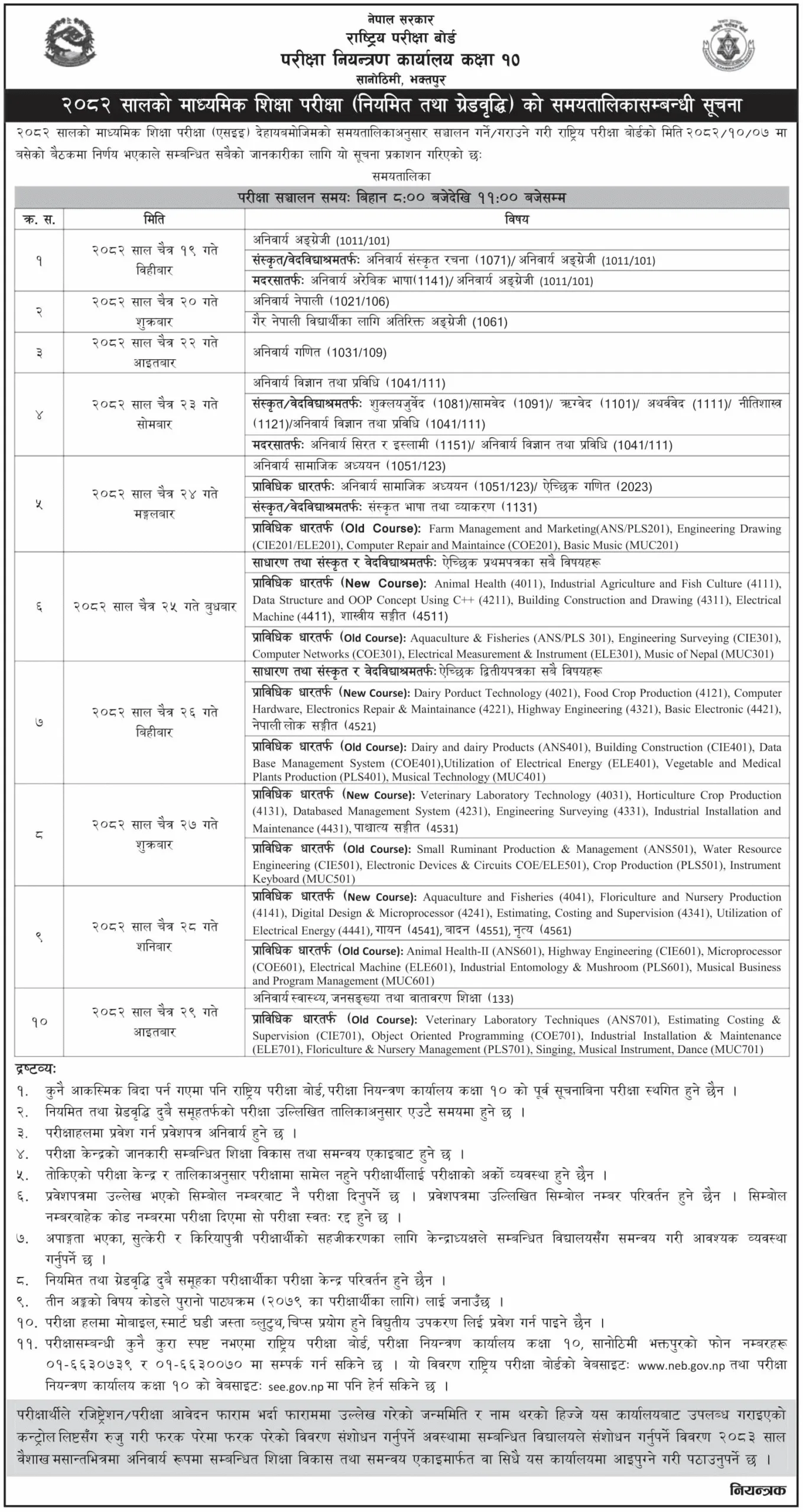
Here’s the detailed SEE Exam Routine for 2082. Make sure to mark these dates on your calendar and plan your studies accordingly.
| Exam Date | Day | Subjects |
| Chaitra 19, 2082 | Thursday | Compulsory English (1011/101) Sanskrit/Vedavidyashram: Compulsory Sanskrit Rachana (1071) / Compulsory English (1011/101) Madrasa: Compulsory Arabic Language (1141) / Compulsory English (1011/101) |
| Chaitra 20, 2082 | Friday | Compulsory Nepali (1021/106) Non-Nepali students: Additional English (1061) |
| Chaitra 22, 2082 | Sunday | Compulsory Mathematics (1031/109) |
| Chaitra 23, 2082 | Monday | Compulsory Science and Technology (1041/111) Sanskrit/Vedavidyashram: Shukla Yajurveda (1081) / Samaveda (1091) / Rigveda (1101) / Atharvaveda (1111) / Nitishastra (1121)/ Science & Tech (1041/111) Madrasa: Compulsory Sirat And Islami (1151) / Science & Tech (1041/111) |
| Chaitra 24, 2082 | Tuesday | Compulsory Social Studies (1051/123) Prabidhi Thar: Social Studies / Optional Mathematics (2023) Sanskrit/Vedavidyashram: Sanskrit Language and Grammar (1131) Prabidhi (Old Course): Farm Management and Marketing(ANS/PLS201), Engineering Drawing(CIE201/ELE201), Computer Repair and Maintaince(COE201), Basic Music(MUC201) |
| Chaitra 25, 2082 | Wednesday | General & Sanskrit/Vedavidyashram: All Optional First Paper subjects Prabidhi (New): Animal Health (4011), Industrial Agriculture and Fish Culture(4111), Data Structure and OOP Concept Using C++ (4211), Building Construction and Drawing (4311), Electrical Machine (4411), Classical Music (4511) Prabidhi (Old Course): Aquaculture and Fisheries (ANS/PLS 301), Engineering Surveying (CIE301), Computer Networks (COE301), Electrical Measurement and Instrument (ELE301), Music of Nepal (MUC301) |
| Chaitra 26, 2082 | Thursday | General & Sanskrit/Vedavidyashram: All Optional Second Paper subjects Prabidhi (New Course): Dairy Product Technology (4021), Food Crop Production (4121), Computer Hardware, Electronics Repair And Maintenance (4221), Highway Engineering (4321), Basic Electronic (4421), Nepali Folk Music (4521) Prabidhi (Old Course): Dairy and dairy Products (ANS401), Building Construction (CIE401), Data Base Management System (COE401), Utilization of Electrical Energy(ELE401), Vegetable & Medical Plants Production (PLS401), Musical Technology (MUC401) |
| Chaitra 27, 2082 | Friday | Prabidhi (New Course): Veterinary Lab Technology (4031), Horticulture Crop Production (4131), Database Management System (4231), Engineering Surveying (4331), Industrial Installation and Maintenance (4431), Western Music (4531) Prabidhi (Old): Small Ruminant Production And Management (ANS501), Water Resource Engineering (CIE501), Electronic Devices And Circuits (COE/ELE501), Crop Production (PLS501), Instrument Keyboard (MUC501) |
| Chaitra 28, 2082 | Saturday | Prabidhi (New Course): Aquaculture and Fisheries (4041), Floriculture and Nursery Production(4141), Digital Design & Microprocessor (4241), Estimating, Costing and Supervision (4341),Utilization of Electrical Energy (4441), Gayan (4541), Vadan (4551), Nritya (4561) Prabidhi (Old): Animal Health-II (ANS601), Highway Engineering (CIE601), Microprocessor (COE601), Electrical Machine (ELE601), Industrial Entomology & Mushroom (PLS601), Musical Business & Program Management (MUC601) |
| Chaitra 29, 2082 | Sunday | Compulsory Health, Population & Environment Education (133) Prabidhi (Old Course): Veterinary Lab Techniques (ANS701), Estimating Costing & Supervision (CIE701), Object Oriented Programming (COE701), Industrial Installation and Maintenance (ELE701), Floriculture and Nursery Management (PLS701), Singing, Musical Instrument/Dance (MUC701) |
Why is the SEE Exam Routine Important?
The SEE Exam is one of the most important exams in Nepal. It marks the end of your school life and opens the door to higher education. Knowing the exam dates in advance helps you plan your studies better. Here’s why the SEE Exam Routine is important:
- Better Time Management: You can create a study schedule based on the exam dates.
- Focus on Weak Subjects: You can spend more time on subjects you find difficult.
- Reduce Stress: Knowing the dates in advance helps you avoid last-minute stress.
How to Download the SEE Exam Routine 2082
It’s a good idea to keep the SEE Exam Routine on your phone or print it out. Here’s how you can download it:
- Visit the official NEB website: https://see.gov.np.
- Look for the SEE Exam Routine 2082.
- Download the routine and save it on your device.
Tips to Prepare for the SEE Exam
Here are some simple yet effective tips to help you prepare for the SEE Exam:
- Create a Study Plan: Divide your time wisely. Spend more time on subjects you find challenging.
- Practice Past Papers: Solve previous years’ question papers to understand the exam pattern.
- Take Breaks: Don’t study for hours without breaks. Take short breaks to refresh your mind.
- Stay Healthy: Eat healthy food, drink plenty of water, and get enough sleep.
- Stay Positive: Believe in yourself. A positive mindset can make a big difference.
How to Check SEE Exam Results
After the exams, you can check your SEE results easily. Here’s how:
- Visit the official NEB website: https://see.gov.np.
- Enter your symbol number to view your result.
Want to calculate your GPA based on your SEE grades? Use our SEE GPA Calculator to easily find out your GPA!
Final Words
The SEE Exam is a big step in your academic journey. With the SEE Exam Routine 2082 in hand, you can plan your studies effectively and stay organized. Remember, hard work and consistency are the keys to success. Follow the tips mentioned above, stay focused, and give your best in the exams. Best of luck to all the students appearing for the SEE Exam 2082!
Frequently Asked Questions (FAQs)
What if I miss an exam?
Unfortunately, there’s no re-exam. Make sure to check the routine and attend all exams on time.
Can I download the SEE Routine in PDF?
Yes, you can download the SEE Routine 2082 in PDF format from the official NEB website.
What are the passing marks for SEE?
You need to score at least 35% in each subject to pass. If you get ‘NG’ in up to two subjects, you can take a supplementary exam.
How can I prepare for the SEE Exam effectively?
Create a study plan, practice past papers, and stay consistent with your studies. Don’t forget to take breaks and stay healthy.
How many students got 4 GPA in SEE 2082?
The results for SEE 2082 have not been announced yet. The number of students who will score 4 GPA will be available after the results are published, likely in the second week of Ashar 2082.
Will there be a SEE in 2082?
Yes, the SEE (Secondary Education Examination) will be conducted in 2082. The exams are scheduled to start on Chaitra 19, 2082 and end on Chaitra 29, 2082.
How to check SEE Result 2082?
You can check your SEE Result 2082 in two ways:
Online: Visit the official NEB website: https://see.gov.np and enter your symbol number.
What is the date of SEE?
The SEE exams for 2082 will start on Chaitra 19, 2082 and end on Chaitra 29, 2082. The exams will be held from 8:00 AM to 11:00 AM every day.
Will there be SEE in 2082?
Yes, the SEE will be conducted in 2082. The exam dates and routine have already been announced by the National Examination Board (NEB).
How many students got 4 GPA in SEE 2082 in Nepal?
The results for SEE 2082 are not yet out. The number of students who will score 4 GPA will be available after the results are published, likely in Ashar 2082.
When did SEE start in Nepal?
The SEE (previously known as SLC or School Leaving Certificate) has been a part of Nepal’s education system for many years. It was introduced as the final examination for grade 10 students to complete their secondary education.